The Value Proposition

Why should a consumer buy from you?

Competitive Advantages

What makes you better than your competition?

Choosing A Differentiation Strategy

You chose a target market, now what?

Thursday, February 20, 2014

Marketing 101: Selecting An Overall Positioning Strategy - Value Proposition

There are buzz words and phrases in marketing & branding that seem to have an "aura" or "mystery" revolving around them.  There are also phrases and words that people who have careers in marketing don't understand at all.  One of the most used terms in existence is the Value Proposition.  Yet, so many of my colleagues don't really know what one is, or how to use it.  So let's spend some time defining it and exploring what it is and how you use it.

What Is A Value Proposition?
Simple question, right? Yet...it's a bit of a complicated answer. So if I'm going to define this as simply as possible, I'm going to say it like this: A Value Proposition is the full positioning of a brand, product or service.  If I were to expand on the definition, then I would say that a Value Proposition is the full mix of benefits that the brand, product, or service is differentiated and positioned upon.  A Value Proposition answers the question: "Why should I buy this?"


Above is a fairly standard illustration of the matrix of Value Propositions.  On the top, we have three Price categories: More, The Same, and Less.  On the side, we have three Benefits categories: More, The Same, and Less.  So when we assemble a Value Proposition, we are pairing a level of Benefit, with a level of Price.  For example, I may choose to take a More for the Same approach, meaning I'm going to offer more features and benefits than my competitors, for the same price.

The combinations in the matrix that are green represent the most favorable approaches to take with your Value Proposition.  Those in red are rarely profitable, and tend to lead to problems or a loss of focus down the road.

Let's begin exploring some of these categories of Value Proposition.

More For More
When we tout a "More For More" value proposition, we are telling the consumer that we are providing them the best possible product or service, and we are charging a higher (some would say "premium") price to cover the costs of giving you the "best".

In the real world, it is easy to see who the "More For More" players are.  One of my favorites is Apple.  They are not shy about "More For More". Apple gives you the best design, the best quality, the best experience, at a price that meets their corporate goals for gross margins and profits.  When a company truly stands behind this value proposition, giving the consumer a premium product, with premium service and an experience that is consistent over time (the Macintosh has been around for 30 years), then it can be very successful.

In order to compete in a "More For More" market segment, you are going to have to find a product or service category that is under-serviced.  If there is a void in the market segment for a premium product, and if the market segment has consumers that can afford a premium product, then you can consider moving in to that area.  However, there are cons to following a "More For More" value proposition.  When you have a premium product, there will always be imitators that will produce a similar product or service, and claim that it has the same quality for a lower price.  Amazon has been marketing it's Kindle Fire HD as a higher quality, lower priced alternative to Apple's iPad Air tablet.  "More For More" brands, products and services will always be under fire by those who use a "More For The Same" or "The Same For Less" value proposition.

More For The Same
How do you counter a "More For More" competitor?  You present a "More For The Same" value proposition.  A "More For The Same" value proposition entales offering a product, service or brand with comparable quality, at a lower price.  Depending on the costs associated with producing your product or service, you may have the same margins as a "More For More" competitor, or you have have smaller margins, which you are hoping to make up for with a higher volume of sales.

What does "More For The Same" look like in the marketplace?  The auto industry is a great example. Lexus, Infinity, Kia and Hyundai are perfect examples.  Lexus and Infinity were the first to attempt to uproot major luxury "More For More" brands such as Mercedes, BMW and Cadillac.  Offering more car, for the same (and usually lower price), these brands were able to take away more and more market share. As a result, Mercedes and BMW realized that there were more customers available at lower price points.  More recently, Hyundai and Kia have followed the same approach, introducing their Genesis and Cadenza models to the marketplace.  However, "More For The Same" can fail, if you are not backing up your value proposition with the quality and features that you claim you are providing the consumer.

The Same For Less
Probably the most powerful Value Proposition is "The Same For Less". Why?  Because we all love getting a great deal.  Great product?  Lower price?  Yes please!  Need a high quality PC for less?  Get a Dell.  Need great quality food, clothes, and electronics?  Go to Costco.  Want door busting deals on name brand electronics?  Go to Best Buy or Fry's Electronics.  Need name brand groceries for much less?  Go to Winco.  You get the idea.

Less For Much Less
If you remember my discussion of social and economic groups, then you know the reality of the consumer: few people want, need, or can even afford the very best products and services.  As a result, there will always be a market for value products.  "Less For Much Less" is summed up with a definition of "offering a brand, product, or service of less quality, for a lower price".   In most cases, the reality of a consumer's monthly budget forces a consumer to stick with "needs" over "wants" during the buyer decision process.

This means you are going to provide a lower "performing" product (less quality and features), at a much lower price.  This also means that you are usually relying on a higher volume of sales to make up for much lower margins.

More For Less
I'm going to briefly touch on one Value Propositional tactic that we see fairly often in the marketplace.  "More For Less".  That's what we all want, right?  More features, more product, more value, for a really low price.  We typically see "More For Less" when a new brand is entering a target market with established players.  Many claim to offer "More For Less" today.

At first it's easy to do.  You are ripe with new investment capital, or you are a large company that has just budgeted a large amount of money towards a new product segment. So you market your product, and sometimes sell it at a loss, offering more features, for a better price.  However, over time, it becomes very hard to maintain a "More For Less" value proposition.  Companies will typically fall into this trap: losing focus.  With each new generation of your product, you will add more features.  All of this product development, all of this marketing, costs money.  Lots of it.  And unless you have other products in your stable that are selling well and creating profits, you will have to raise the price of your product in order to cover the costs associated with bring it to market.  If you don't, you lose money.  Not only are you losing money, but your product and your brand become so "busy" and "cluttered", you begin to lose out to your competitors, who are more focused, and have a more focused product and message.  In essence, you eventually confuse your consumers, and once your prices go up, they look elsewhere during the buying decision process.  Stay away from "More For Less", unless you can keep your focus, and you can manage your bottom line.

Monday, October 21, 2013

Marketing 101: Choosing the Right Competitive Advantages

Previously I explored the concept of Market Differentiation which involves Product Positioning through a Value Proposition.  Recall that a Value Proposition is not a "mystical" marketing term, but in fact is an essential marketing principle.  A Value Proposition consists of two parts: a differentiated value, and a position.  The differentiated value refers to the ways our products and services stand out from the competition inside a chosen market segment.  The Value Proposition helps us develop a Differentiation Strategy which effectively focuses and communicates our intended position to the selected target market, and gives us sources of competitive advantages.

Evaluating Brand Differences
The truth is some differentiators are not meaningful or worthwhile to consumers - they won't "speak" to them in your messaging.  The other often overlooked reality is that each differentiator used in your marketing strategy creates costs for the company (your marketing budget), as well as benefits for the consumer.  Therefore each differentiator we choose must be evaluated according to the following criteria:

1) Importance: Does the difference deliver a highily valued benefit to the target customer?
2) Distinctiveness: Do your competitors also offer the difference? Can you offer it to customers in a more distintive and meaningful way?
3) Superiority: Is the difference superior to other ways that customers can obtain the same "benefit"?
4) Communicable: Can the difference be easily communicated and also visible to consumers?
5) Preemptive: Is it difficult for your competitors to copy the difference?
6) Affordable: Can consumers afford to pay for the difference?
7) Profitable: Are you able to introduce the difference profitably?

The ideal differentiators are the ones that meet all 7 of the above criteria fairly well.  If you are entering a target segment that has very little competition, this is entirely possible.  However if there are already a few well established products in the segment, then you will need to position yourself via multiple differentiators, and your differentiators may have a more difficult time being truly distinctive, preemptive, and important.


Monday, August 5, 2013

Marketing 101: The First Step of Market Differentiation

In our previous discussion we defined a Target Market as a set of buyers that share a set of common needs or characteristics that we decide to serve.  When targeting a market segment we examine three factors: a segment's size and growth trends, a segment's structural attractiveness, and a company's long term objectives and available resources. Once we've defined the target market, and chosen one of four appropriate marketing methods, our eyes turn towards Market Differentiation and Product Positioning through a Value Proposition.

A Value Proposition is not a mystical marketing term, it is an essential marketing principle.  A Value Proposition consists of two parts: a differentiated value, and a position.  The differentiated value refers to ways our products and services stand out from the competition inside a market segment.  A position is the "place" the product occupies inside the consumer's mind relative to competing products in the market segment.  Let's address "position" first.

Depending on the product or service, the Buying Decision Process can be tough.  To simplify it, consumers will organize products and services into categories and "position" them inside their minds relative to others.  This position is built from the consumer's underlying sets of perceptions, impressions, and feelings about a product.  We all naturally do this, without any help from advertising.  It's human nature - we are chronic "judgers".  The painful reality for a marketer is that we cannot leave this natural act of positioning to chance - we MUST influence it.  A marketer must first define the positions we want our products and services to occupy, and then create the messaging that will influence consumers and give us a competitive advantage.  A great way to plan and visualize positioning is by using Position Maps.

Position Maps
Position Maps are great tools we can use to understand how consumers perceive us versus other competing products. A position map uses two axis.  Each axis represents a qualitative or quantitative attribute.  Usually using data acquired through primary or secondary sources, we can graph visually where each product is positioned according to the relationships between the two axis.


What you see in the map above is a visual plot of the positioning of common brands of candy.  If we were developing a new brand, or trying to reposition an existing one, we can use this map to help guide our differentiation and messaging strategies going forward.

Choosing Differentiation Strategies
The reality is that two or more firms will go after the same position in a targeted segment.  A Differentiation Strategy helps us effectively focus and communicate our intended position to the selected target market, and gives us a source of competitive advantage. Differentiation strategies help us describe the differences between our products and services versus our competition.  The result of successful differentiation is that categorization by the consumer becomes harder, which reduces comparisons of our products and services with our competition.

Choosing a differentiation strategy generally consists of three steps:
1) Identifying a set of possible customer value differences that provide competitive advatages upon which to build the position.
2) Selecting the best competitive advantages.
3) Creating the overall positioning strategy.

Step 1: Identifying A Set Of Value Differences
If we are able to position our products and services in a manner that sets them apart from our competition, then we have gained a competitive advantage and our position in the comsumer's mind will be higher than the alternatives available.  In order to gain this competitive advantage we can differentiate through products, services, channels, people, or image (brand).

Products
Our ability to differentiate ourselves solely on the actual product is dependent on the "sliding scale" of product features.  At one end are products that have few real "features" to sell - such as beef, pencils or cartons of milk.  The other end is occupied by highly differentiated products, with abundant real "features", such as cars, computers and homes.

Services
Services are defined as "what accompanies the product".  Let's use an automobile as an example.  When you buy a Ford, consumers can expect a fairly mainstream level of dealer service.  Lexus differentiates itself with a higher level of service: luxurious lounges and brand new Lexus loaner cars are the norm for owners of these automobiles. 

Channels
Differentiation through channels involves every touch point along the way to finally getting the product into the consumer's hands.  Companies enjoy competitive advantages via channel differentiation due to the way they design their channel's coverage, expertise, and execution. Companies such as Dell, Apple, and Amazon have created some of the most well executed direct to consumer channels in their industries.

People
Companies can use their own "people resources" as points of differentiation.  Grocery stores, retail outlets, call centers, theme parks, and even hospitals all use people as points of differentiation.  Where there is a customer touch point, you can differentiate via people.

Brand Image
In some ways, using brand as a point of differentiation seems the simplest to understand.  When you think about some of the most common brands in the marketplace, odds are you already have distinctly positioned them in your mind.  The caveat is that it is only "easy" to leverage a brand as a point of differentiation if it is well established in the marketplace.  If you are relatively new, or unknown, then it is much harder to differentiate solely on brand. In this case you can use brand as a smaller complementary component of your differentiation strategy.  The goal with brand differentiation is to convey your product's distinct benefits and positioning through brand messaging.  If you are going to use brand differentiation, you must remember that you cannot develop your image in the consumer's mind overnight; it takes long term commitment throughout all company micro-environments.  You literally must live and breathe the essence of your products and company.

Regardless of how you choose to differentiate your products and services, they key take-away is this: it is impossible to offer products and services that are built upon empty promises.  We must live according to our promises and slogans on a daily basis at all customer touch points.

Thursday, July 11, 2013

Marketing 101: Market Targeting

Recall that a customer driven marketing strategy consists of four distinct "steps".  Previously I focused on the first step: Segmentation.  I defined Market Segmentation as dividing a market into smaller groups that contain distinct needs, characteristics, or behaviors that may require distinct products, services and marketing mixes.  Because buyers have different wants, desires, needs, geographic locations, economic resources, buying attitudes, and buying practices, we use segmentation to divide markets into "pieces" that can be reached more effectively.  Market segmentation reveals our potential opportunities.  Once we have segmented the market, we must decide what parts of it to target.

Targeting the Market
We can define a Target Market as a set of buyers that share a set of common needs or characteristics that we can decide to serve.  When targeting a market segment we must look at three factors: a segment's size and growth trends, a segment's structural attractiveness, and our own company's long term objectives and available resources. The first factor consists of the type of research we have explored in the past when discussing Primary Data.  It is vitally important that we collect and analyze data on current segment sales, it's growth rates and potential profitability.  Once we have that data, we must compare it to the size and growth characteristics that our own company is seeking.

Next, we must investigate the segment's major structural factors that will determine how attractive our participation will be.  There are many reasons a segment may appear unattractive.  First, a segment is generally less attractive if it contains numerous strong and potentially aggressive competitors.  More competition usually results in many alternative products that create price competition and limit available profits.  Second, a segment is less attractive if buyers have more power, forcing participants to keep prices lower in order to increase market share, which also reduces  profits.  Third, a segment is less attractive if there are suppliers with strong influence in the micro-environments that actively try to hold material costs at a certain level, with increases our cost of goods, which also reduces potential profits.

Once we have produced a detailed evaluation of the target's structural factors, we must consider our own long term objectives and available resources.  Quite frankly, your company may not have the skills, knowledge, intellectual property and resources to succeed in a particular market segment.  A company should enter a segment only if they can offer outstanding value and can gain and retain competitive advantages over other companies in a given segment.

Choosing a Marketing Method
Once you have selected an attractive market segment, it's time to determine the marketing mix through a targeted marketing method.  Targeted Marketing is generally conducted at four distinct levels.  These levels are based on the relative size of the targeted segment.  In order of large to small, these levels are: Undifferentiated Mass Marketing > Differentiated Segmented Marketing > Concentrated Niche Marketing > Micro-marketing at a local or individual level.

Undifferentiated Mass Marketing
Undifferentiated Mass Marketing is a marketing strategy where a company chooses to ignore market segment differences (presented by their Primary and Secondary Data) and go after the whole market with one distinct product offering.  This type of strategy focuses on the most common needs of consumers, rather than on what is distinctly different between them.  This is a classic strategy from the early to mid-1900's, with the goal of appealing to the largest group of buyers possible in order to create as many sales as possible.  This is the classic volume-based tactic.  Product margins are low, and the value given to the customer is marginal as well.  Most modern marketers do not believe this strategy is very effective.  Today it is very difficult to make a product that appeals to mass-markets due to extreme competition from more focused niche products.

Differentiated Targeted Marketing
Differentiated Targeted Marketing is a strategy where we select several market segments, and design focused products and marketing mixes for each one, with the goal of higher sales and a relatively stronger position within each segment.  The advantage of Differentiated Targeted Marketing is that it typically gives a company higher gross sales across segments.  However increased sales also bring increased costs, because it can be more expensive to develop and produce 10 units of 10 different products (versions that are focused towards specific types of buyers) than 100 units of one product (for mass appeal or niche segments).  It also costs more to market for multiple segments, because each segment requires separate marketing research, analysis, planning, and channel management.  Due to these disadvantages, a marketer must weigh the prospects of increased sales versus the potential increased cost of business when choosing a differentiated marketing strategy.

Concentrated Marketing
Concentrated Marketing is a marketing strategy where a firm chooses to pursue a large share of one distinct segment or a few segments or niches.  Concentrated Marketing allows a company to achieve a stronger market position within a segment due to their greater knowledge of consumer needs and desires within that segment, fine tuning product features and prices over time in responsive to changing trends.  Concentrated Marketing is very appealing for companies that have relatively limited resources for product development and marketing.   Concentrated Marketing is also attractive, because segments are generally smaller and usually attract very few competitors, allowing for higher margins.  However Concentrated Marketing comes with higher than normal risks.  Because most of your business is focused within one or few segments, you may suffer large financial losses a segment turns sour at any time. 

Micro-Marketing
Micro-Marketing is a strategy where companies tailor products and marketing mixes to the needs and wants of specific individuals or local consumer groups.  Micro-Marketing generally involves consumers in all phases of product development, giving consumers opportunities to practice self-marketing during the buying decision process.  Micro-Marketing can give consumers extraordinary value, and can give the companies extraordinary value and consumer equity in return.  However Micro-Marketing tends to increase product development and marketing costs by reducing natural economies of scale inherent in manufacturing.  Micro-Marketing is also logistically complicated due to the numerous requirements of executing different regional and local marketing mixes.

Once you have evaluated and chosen a segment to target, we must work on Differentiation: differentiating the market offering (ie: the product) and thereby creating superior customer value.  I will explore this topic in my next post.

Tuesday, June 4, 2013

Marketing 101: Market Segmentation

In my overview of Customer Driven Targeted Marketing, I stated that no human being is like another. Two people may be very similar, but they will always be different consumers, influenced by different attitudes and beliefs. As marketers we have to accept the fact that we can't appeal to all types of buyers in the marketplace, and there is just no way to appeal to any two buyers in the exact same way.  I also stated that in order to achieve maximum value from consumers according to our working definition of marketing, we need to focus on the right target customers that will give us the right relationships that achieve maximum customer value and equity.  To do this we use Customer Drive Targeted Marketing.

Segmentation
Recall that a customer driven marketing strategy consists of four distinct "steps".  Let's focus on the first step: Segmentation.  Market Segmentation is defined as dividing a market into smaller groups that contain distinct needs, characteristics, or behaviors that may require distinct products, services and marketing mixes.  Because buyers have different wants, desires, needs, geographic locations, economic resources, buying attitudes, and buying practices, we use segmentation to divide markets into "pieces" that can be reached more effectively.  However, there is no one standard way to segment a market.  Marketers have to segment using multiple combinations of variables in order to find the best way to view the target market.

Marketers use many variables to segment a market.  The major variables we use can be divided into standard categories such as:

1) Geographic - includes world region or country, city or metro size, density, climate
2) Demographic - includes age, gender, family size, famliy life cycle, income level, occupation, education, religion, race, generation, nationality
3) Psychographic - includes social class, lifestyle, personality
4) Behavioral - includes special occassions, benefits, user status, user rates, lotalty status, purchase readiness stage, attitude towards products and brands

With so many variables available to marketers for the purposes of segmentation, it would be so easy just to pick on or two variables and "call it a day".  However, what experienced marketers know is that we rarely limit our segmentation analysis to one, two, or even a few variables.  Marketers are using more segmentation bases today than in the past in an effort to identify more focused groups of consumers.

However, using more variables does NOT guarantee that our segmentation base is effective.  In order for a segmentation to be effective, it must meet the following criteria:

Be Measurable
Be Accessible - The targeted customers can be actively reached and served.
Be Substantial - The targeted group is large enough and profitable enough size-wise to serve.
Be Differentiable - The targeted group is conceptually distinguishable and responds differently to different markeing mix elements and programs.
Be Actionable - The targeted group can be designed for attracting and servicing the segments.

Once we have defined and chosen our market segment, we can work on targeting the segment.  My next post will discuss targeting.

Friday, May 10, 2013

Marketing 101: Overview of Customer Driven Marketing Strategies

One thing is for sure, no human being is like another. Two people may be very similar, but they will always be different consumers, influenced by different attitudes and beliefs. As marketers we have to accept the fact that we can't appeal to all types of buyers in the marketplace, and there is just no way to appeal to any two buyers in the exact same way.

In order to achieve maximum value from consumers according to our working definition of marketing, we need to focus on the right target customers that will give us the right relationships that achieve maximum customer value and equity. Stop for a moment and notice that I wrote the word "target". This was not a coincidence.

Decades ago, most marketing money was allocated towards mass marketing efforts. Products and services were created to attract and serve as many customers as possible. It was thought that the best way to make as much money as a possible was to sell as many products as possible to as many people as possible. The concept of customer equity wasn't even a part of the mindset of the marketer.

Mass Marketing (also known as undifferentiated marketing) is a marketing strategy that originated in the 1920's as a way of appealing to as many potential buyers in the marketplace as possible. Mass Marketers choose to ignore market segment differences and try to appeal to as large of a customer base as possible with a single product offering. The marketer is assuming that their product meets the needs of an entire population of consumers, and that they can appeal to those consumers in the same way. Mass Marketers aim to broadcast their messaging to as many people as possible, as often as possible. Traditionally mass marketing has focused on the mediums of radio, television and print due to their reach. The marketer assumes that by reaching the largest audience possible, exposure to the product is maximized and sales will be at their maximum.

However there are clear disadvantages to mass marketing practices.  First, we know now that consumers don’t all think alike; so what works well for one group of consumers does not always translate well for another. Second, consumers are becoming less and less interested in "standardized" products (think canned soup), and are very willing to pay higher prices for products that cater to their needs and desires.  Third, mass marketing usually involves much higher costs, especially for the corresponding media buys.  For smaller companies with smaller marketing budgets, mass marketing just isn't possible.  A more focused, budget-effective method of marketing is required: Customer Driven Targeted Marketing.

Customer Driven Targeted Marketing
Because of its advantages and the reality that all companies differ in their abilities to serve different market segments, most marketers have shifted over to customer driven targeted marketing.  In the process of creating a targeted marketing plan we identify one or more marketing segments, and then develop products and marketing programs that are "targeted" to each type of consumer we are pursuing.  A customer driven marketing strategy consists of four distinct "steps", typically grouped into two groups:

1) Selecting The Right Customers To Serve:
-Via segmentation: by dividing the total mass market into smaller segments
-Via targeting: by selecting the right segment or segments of the marketplace to enter

2) Deciding On a Unique Value Proposition:
- Via differentiation: differentiating the market offering (ie: the product) and thereby creating superior customer value
- Via positioning: placing the product offering in the minds of the target consumer with the right messaging

These four steps create value for the target consumer, and allow us to receive value from them.  Over the next few posts I will be diving in further to the Customer Drive Targeted Marketing process.

Monday, April 8, 2013

Marketing 101: Post-Purchase Behavior

So far I've examined four of the five stages of the Buyer Decision Process: Need Recognition, Information Search, Evaluation of Alternatives, and the actual Purchase Decision.  We've discovered that each stage is complicated, and that marketers will need to understand their customer's journey as they construct meaningful campaigns and messaging.  These statements are even more important to reckon with in the last stage of the Buyer Decision Process: Post-Purchase Behavior.

What is Post-Purchase Behavior?
Simply defined, Post-Purchase Behavior is the stage of the Buyer Decision Process when a consumer will take additional action, based purely on their satisfaction or dissatisfaction.  The consumer's level of satisfaction or dissatisfaction is directly related to the varying relationship between their initial expectations of the product (pre-purchase), and their perception of the actual performance of the product (post-purchase) in their hands.

If after the purchase the consumer perceives the product's performance as matching their expectations, or even exceeding them, they will be "satisfied".  If their perception of the product's performance is less than their expectations, then the consumer will feel "dissatisfied".  The larger the gap between their expectations and the product's performance, the more dissatisfaction.  This dissatisfaction leads to Cognitive Dissonance.

Cognitive Dissonance is buyer discomfort caused by post-purchase conflict resulting from dissatisfaction.  The reality is that all purchases, big and small, will result in some degree of Cognitive Dissonance.  This is always the case, because every purchase a consumer makes involves some sort of compromise, however small or minute.  Since consumers form beliefs and attitudes early in the Buyer Decision Process, at some point they will be concerned about having a negative experience with the product they may chose, or potentially missing the perceived benefits of other competing brands.

The issue of Cognitive Dissonance raises an important question: Why is it so important to satisfy the consumer?  It all comes back to our basic definition of marketing: Managing profitable customer relationships.  The goal is to attract new customers through superior value, and to keep growing customers by delivering customer satisfaction.  If we are doing these things, then we will be able to capture value from customers to create profits and build customer equity.  So, if our customers are satisfied they will begin to develop brand loyalty.  This brand loyalty will help us develop profitable relationships.  Our satisfied customers will buy from us again. They will become influencers in their cultural and social groups.  They will pay less attention to competitors, and buy more of our products. 

Dissatisfaction breeds the opposite.  Consumers that perceive poor product performance will not create profits and will erode customer equity.  They will not be loyal, and they will become negative influencers in their cultural and social groups, leading others away from our brands.  What should we do with dissatisfied customers?  We should pursue them.  Even if they do not want to buy our products, we can still target them with dedicated messaging.  We can directly reach out to them, and we can figure out ways to repair the relationship.  These consumers can provide us with a wealth of primary data that can be used to improve our offerings and create focused marketing campaigns.  Dissatisfied consumers are just as valuable as satisfied ones.

The conclusion is clear: Our job is not done once the consumer buys our product.  Once a consumer buys a product they will enter some degree of post-purchase behavior.  These behaviors, based on their satisfaction or dissatisfaction, will either build customer equity and brand loyalty, or lead to eroding sales and brand image issues.  This all is related to their relationship between their expectations and the perceivced performance of the products in their hands.  As marketers, we must have messaging ready for this specific part of the Buyer Decision Process.  It is our job to encourage happy consumers to share their experiences and dive deeper into brand offerings.  It is also our job to be brand advocates by reaching out to dissatisfied consumers and transforming their experience into one that leads to a profitable relationship.


Monday, March 25, 2013

Marketing 101: Purchase Decision

In my examination of the Buyer Decision Process I've explored the first three steps: Need Recognition, Information Search, and the Evaluation of Alternatives. Generally the completion of alternative evaluation will lead to our fourth step, the Purchase Decision.

The Purchase Decision
We can define the Purchase Decision simply as the consumer's choice of which brand to purchase.  Once the consumer forms their beliefs and attitudes about a product segment's brands, the consumer will usually purchase the most preferred brand.  Notice that I said usually.  Sometimes two factors can come between the purchase intention and the purchase decision: the attitudes of others, and unexpected situations.

Sometimes the attitudes of others can change our minds before the sales transaction. For example, someone in a family group or social group might think that you should get an Apple iPad instead of a comparable competitor's tablet device.  If this person is important enough in your life, they may exert enough "peer" pressure to cause you to suddenly alter your attitudes and beliefs, greatly reducing the chances of you buying another brand of tablet.

Your tablet purchasing decision may also be altered by our second factor: unexpected situations.  Consumers will usually form their purchase decisions based on factors such as their current income level, expected prices, and assumed product benefits.  However unexpected events often will change their original purchase intention.  Some examples of purchase altering situations are unexpected sales, competitors dropping their prices, a sudden economic downturn, or a sudden change in employment.

Marketers need to understand that their work is not done once a consumer reaches the point of making a purchase.  Because consumers can, and often will change their minds, consistent messaging needs to be placed in front of the consumer all the way up to the actual sales transaction.  Even then our job is not done.  In my next post I will explore Post-Purchase Behavior.

Tuesday, March 5, 2013

Marketing 101: The Buyer Decision Process: Evaluation of Alternatives

In my examination of the Buyer Decision Process, I've started by exploring the first two stages: Need Recognition and Information Search.  Need Recognition refers to the instance when a consumer recognizes that a need, or problem exists that needs to be satisfied, ie: I need a new refrigerator.  If the need is strong enough, an Information Search is usually initiated.  As a consumer does more research they will inevitably become aware of competing brands and products that are available for purchase.  It is at this point that the Evaluation of Alternatives begins.  An Evaluation of Alternatives is the stage of the buyer decision process in where a consumer uses the information gathered in the Information Search to evaluate alternative brands in the product category.

So how does a consumer choose among these alternatives?  The truth is that there are several processes at work inside the consumer's mind, forming beliefs and attitudes about all of the products to choose from.  However these processes all "evolve" based on the individual's buying situation.  The situation evolves from the set of attributes the consumer is choosing to evaluate products by.

Let's say a consumer is evaluating the attributes of a groups of computers. They have identified four attributes: performance, design, price, and value.  During the evaluation the consumer will place different levels of importance with each attribute based off of what is most important to them.  The consumer will "evaluate" each brand and form beliefs on how each brand rates on each attribute.  The consumer may turn to friends and family, consult consumer reviews, or discuss their situation with sales people during the Information Search.

We know that all brands vary in their degree of appeal to each consumer.  A consumer may buy a brand based on a single attribute, or a number of them.   If during the Information Search you were able to deduce how a consumer assigned value to each attribute you could predict the buying behavior more accurately.  Marketers must study buyers to discover how they actually evaluate brand alternatives.  If you know how your target customer's evaluation process occurs, you can take steps to influence the buying decision early on and lead the buyer to purchase much faster.

Monday, February 25, 2013

Marketing 101: The Buyer Decision Process - Information Search

In my last posted I started to discuss the Buyer Decision Process.  Simply defined, it's conducted by a consumer before, during, and after the purchase of products and services. The process consists of five defined steps or stages that typically occur in a certain order: Need recognition > Information Search > Evaluation of Alternatives > Purchase Decision > Post-Purchase Behavior.

Need Recognition refers to the instance where a consumer recognizes that a need or problem exists that needs to be satisfied.  Need Recognition is usually triggered by an internal stimuli when a particular need, such as hunger or thirst, rises to a high enough level to become a drive.  Once the need has been identified and has become a drive, the pursuit of information begins.

Information Search
Information Search is the second stage of the buyer decision process.  In this stage consumers are driven (by their drive) to search for more information related to their need.  If the drive is strong and a satisfying product is near at hand, the consumer is likely to buy it then, barely collecting any information, or skipping this stage altogether.  If the drive is not strong, the consumer will usually store their need in memory and begin an information search.  As a consumer does more research they will inevitably become aware of competing brands and products that are available for purchase. 

Appliances are a product category where consumers conduct lots of research and there is ample competition.  Let's say a consumer needs to replace their refrigerator.  Because the most effective sources of information tend to be personal in nature, a consumer might start their information search by asking members of their friends and family social and cultural groups what refrigerators they would recommend.  Next, the consumer will typically begin to use commercial sources of information to "fill in the blanks", such as advertisements, editorial reviews, and in-store sales staff.

Marketers must design their marketing mix to make target customers aware of their brand in the midst of all of this "noise".  Ad messaging must address the typical needs, lifestyle aspirations and answer the common questions of their target demographics.  Sales staff must be properly trained and incentivized so that in-store touch points are as successful as possible.  If a marketing mix is properly created, it can help accelerate consumers quickly past the Evaluation of Alternatives stage and towards the Purchase Decision.


Monday, February 4, 2013

Marketing 101: The Buyer Decision Process - Need Recognition

Over the past few months we've spent the majority of our time exploring the many ways consumers are influenced throughout the buying process.  First was an overview of Consumer Buying Behavior, which we placed into the Model of Consumer Buyer Behavior.  We summarized that [1] Consumers "ingest" marketing and other stimuli, such as the four P's: Product, Price, Place and Promotion [2] the stimuli enters their "buyer black box" [3] the "black box" creates buyer responses.

Next we looked at Cultural Factors affecting consumer purchases, noting that Cultural Factors are some of the strongest influences of consumer buyer behavior, because they are the set of basic values, perceptions, wants and behaviors that are "learned" by a consumer from their families and other important social institutions.  Also recall the fact that we need to remember that every group or society has a culture influencing them in some form or degree.

Along with cultural factors, there are also Social Factors affecting consumer buyer behavior.  Human beings are social, and they need people around them to interact with and to discuss various issues in order to reach better solutions and ideas.  We learned that these social factors typically consist of the consumer's small groups, their family, and their social roles and status.  We also learned about social roles such as Initiators, Influencers, Deciders, Buyers, and Users.  These roles play a part within social groups consisting of friends and familes.  We also quickly examined how economic status enables or disables a person's abilties as a consumer.

On top of the social factors affecting consumer buyer behavior, we also have Psychological Factors.  The consumer's own personality is constructed by the unique psychological characteristics that create relatively consistent, lasting behavior in response to their own environment.  These characteristics include Self Concept, Motivation and the five motivational needs, Perception, Learning, and Beliefs and Attitudes.  In summary, all of these factors and stimuli illustrate an important point: consumers are complicated.  Now let's see how complicated reaching a buying decision can be.

Defining the Buyer Decision Process
The Buyer Decision Process is conducted by a consumer before, during, and after the purchase of products and services.  Purchasing decisions are usually considered to be psychological constructs, because although we never "see" a decision, usually we infer from observed behaviors that a decision has been made. Therefore we are able to conclude that a psychological event, the "decision", has occurred. This assumption of a process suggests a commitment to action; that commitment to buy.

The Buyer Decision Process is usually split up into 5 distinct stages that typically occur in a certain order: Need recognition > Information Search > Evaluation of Alternatives > Purchase Decision > Post-Purchase Behavior.  This order seems to suggest that a consumer will pass through all five stages, however this is not always the case. Often with habitual buying behavior a consumer will usually skip or reverse some of these steps in the Buyer Decision Process.  However one step, Need Recognition, is never skipped.

Need Recognition
The first stage of the buyer decision process is Need Recognition.  Need Recognition refers to the instance where a consumer recognizes that a need or problem exists that needs to be satfisfied.  Need Recognition is usually triggered by an internal stimuli when a particular need, such as hunger or thirst, rises to a high enough level to become a drive.

External stimuli can also create a need and lead to drives.  For example, advertisements that consumers hear and see, or discussions with other people can cause them to consider buying a particular product.

When preparing a campaign and settling on your target audience, you need to conduct research that helps you define the needs of the consumer, how the needs arose, what stimuli brought them about, and how that stimuli led the consumer to determine they needed your product.

Monday, January 14, 2013

Marketing 101: Variety Seeking Buying Behavior

In previous posts I examined Complex Buying Behavior, Dissonance-Reducing Buying Behavior, and Habitual Buying Behavior.  Finally, we will quickly define Variety Seeking Buying Behavior.

Variety Seeking Buying Behavior
Variety Seeking Buying Behavior refers to situations where there is low consumer involvement, but the consumer perceives significant differences between the brand options in front of them.  In variety seeking situations consumers tend to do a lot of brand switching.  There is no real brand loyalty.  Common variety seeking types of products are cookies and crackers.  Let's take a quick look at crackers.

Consumers may already have a few beliefs about crackers.  However most consumers will buy a particular brand with very little evaluation before the purchase.  In fact in product categories such as crackers, evaluation tends to happen during consumption of the product.  Beliefs and attitudes will come during the experience of eating them, or using them at parties.  The next time the consumer is ready to buy, they will sometimes buy the same brand if the experience was favorable.  However, they may also pick another brand purely out of boredom or to just try something different.  All of this happens for the sake of variety rather than any negative beliefs or attitudes about the cracker brand.
The marketing strategy might differ for the market leader versus the competitors trying to grab market share.  Leaders should encourage habitual buying - dominating shelf space and keeping shelves stocked, running frequent reminder advertising.

Marketers should encourage variety seekers to buy by using lower prices, special deals, coupons, samples, and ads that have messaging that give reasons for trying something new.

Monday, January 7, 2013

Marketing 101: Habitual Buying Behavior

So far we have examined Complex Buying Behavior and Dissonance-Reducing Buying Behavior.  Next, let's quickly look at Habitual Buying Behavior.

Habitual Buying Behavior
Habitual Buying Behavior refers to situations where a consumer has low involvement in a purchase, and is perceiving very few significant differences between brands in a given product category.  So many products fit into this scenario.  Most of them are everyday use products and commodities, such as toilet paper, salt and black pepper.  Let's consider black pepper.

There isn't much to ground black pepper.  Unless you are actively cooking as a hobby (or a profession), you just need some pepper to throw into your mac-and-cheese or season the mashed potatoes on your plate.  There is very little consumer involvement in this product category.  Typically a consumer will go to the store and reach for a brand.  If the consumer grabs the same brand repeatedly, this is almost always habitual buying, not brand loyalty.

In these scenarios the consumer's buyer behavior doesn't go through the normal belief-attitude-behavior sequence.  Instead, consumers passively learn about low involvement products and brands through passive consumption media - television, radio, and Hulu ads.  Because consumers are buying based on brand familiarity, marketers must use ad repetition to build brand familiarity instead of brand conviction.  In order to encourage sales, marketers will need to use tactics such as price and sales promotions to initiate product trial.

Marketers should create messaging that emphasizes only a few key points.  Marketers should also use more visual symbols and imagery within their advertising, because they can easily be remembered by the consumer and associated with the brand.  Ad campaigns should have high repetition rates and the  duration of messages should be short.

Wednesday, January 2, 2013

Marketing 101: Dissonance-Reducing Buying Behavior

In my last post I examined Complex Buying Behavior.  Next, let's quickly dig into Dissonance-Reducing Buying Behavior.

Dissonance-Reducing Buying Behavior
Just like Complex Buying Behavior, consumers with Dissonance-Reducing Buying Behavior have high amounts of involvement.  However, buyers in this behavioral situation are perceiving very few differences among the brands they are selecting products from.  The key word here is perceiving.  There may be many real differences between the different brands, however the buyer's beliefs about the other brands are that there are very similar or essentially the same.  Let's examine a common product such as paint.

Choosing paint for the interior of your house is an extremely expressive process.  The colors a person may choose are varied and will always vary from person to person depending on their highly personal tastes.  Paint can also be expensive, with some brands costing over $20 per gallon.  When a consumer finds a group of brands in a determined price range, their understanding of the difference between brands may be very low.  As a result, a consumer may do some research, but in the end, they may be swayed by price or convenience of purchase in the end.

Post-Purchase Dissonance
Post-Purchase Dissonance is another way to say "after the sale discomfort".  It's also the on-set of "buyer's remorse".  Post-Purchase Dissonance will begin once a consumer begins to "notice" any disadvantages of their purchase, and begin to hear "good" things about the other products they did not buy.  To counter these feelings, marketers should be running after-sale communication campaigns with focused targeted messaging.  These campaigns should give encouragement and help support consumers, convincing them to continue to "feel good" about their brand choice.  These marketing campaigns should also be encouraging additional purchases or referrals, offering discounts and incentives for additional purchasing.

Tuesday, December 4, 2012

Marketing 101: Complex Buying Behavior

The process consumers use to buy products and services is different for every individual and every category of product.  However, we have been able to categorize this behavior based on their degree of involvement, and the degree of difference between the brands in the product category.  There are four types of Buying Behavior:

1) Complex Buying Behavior - Has high involvement with significant levels of differences between brands.
2) Variety-seeking Buying Behavior - Has low involvement with significant levels of differences between brands.
3) Dissonance-reducing Buying Behavior - Has high involvement with very few differences between brands.
4) Habitual Buying Behavior - Has very low levels of involvement and very few differences between brands.

Let's start by examining Complex Buying Behavior.

Complex Buying Behavior
Complex Buying Behavior defines buying scenarios that are characterized by high levels of consumer "involvement" in a purchase decision; with significant amounts of perceived differences between brands in the product category.  Involvement refers to actions the consumer must take to understand the product or service they are motivated to buy.  When high involvement is necessary, the consumer does whatever they can to learn: research, read reviews, talk to others, and "test drive" different models at retail locations.

High involvement tends to be associated with products that are more expensive, infrequently purchased, technologically advanced, and highly expressive of the buyer's personality profile.
The involvement process helps the consumer understand the differences between the brands of products they are motivated to buy.  This process is where the consumer develops (and sometimes changes) their beliefs and attitudes.  These beliefs and attitudes, along with their buying motives, will influence the consumer's decision.

Marketers of high-involvement products need to have an understanding of the buying process.  It is their job to help the consumer learn about their product, and create messaging that influences the buyer's beliefs and attitudes about competitor's products.  Understanding your target customer's Personality Profile is a key component of your marketing plan.

Tuesday, November 27, 2012

Marketing 101: Pyschological Factors of Consumer Buyer Behavior

Consumers are complicated.   If they bought things based on only a select criteria, then it would be easy to convince others to buy our products and services.  There would be no need for elaborate ad campaigns and large advertising budgets.  Unfortunately, consumers are influenced by many different stimuli, and they use many different factors to decide what to buy and when to buy it.  One of the major influencers of consumer buyer behavior is the consumer's own unique personality.

When we study personality, we are examining the unique psychological characteristics that create relatively consistent, lasting behavior in response to the consumer's environment.  We usually refer to someone's personality by traits, such as self-confidence, dominance, sociability, autonomy, defensiveness, adaptability, and aggressiveness.  Personality is extremely important, because it allows us to build a profile of our customer.  It allows us to really understand who they are, and why they buy.  You can use that profile to better understand how to tailor your products and services to that buyer, and tailor your messaging to be as affective as possible when selling to that customer segment.

Consumers aren't the only ones who can have personalities and profiles.  So can brands.  Brand personalities are the specific mix of human traits that may be attributed to that brand.  In order to better associate our brands with our target customers, we try to give them personalities that are relatable.  We use these personalities to tailor the look and perception of the brand and its messaging in the marketplace so that we can attract specific consumers to our products and services.

Self Concept
Many marketers use a concept related to personality, called Self-Concept.  The main premise of self-concept is that a consumer's possessions directly contribute to, and directly reflect their identities. Basically a person "is" what they have.   Therefore, marketers try to understand our target customers by the things that they own and the things that they buy. 

When we know the buyer's personality, when we have defined our brand personality, and when we have attempted to understand our consumer buy their existing buying patterns, we then combine all of this along with specific psychological factors to better understand their buyer behavior.  Currently we look to four specific factors of our target customers when building their personality profile:

1) Motivation
2) Perception
3) Learning
4) Beliefs and Attitudes

Let's examine these one by one.

Motivation
A motive is a need that has become so sufficiently pressing that it directs the consumer to seek satisfaction of that need.  A consumer has a number of needs at any given time of their life.  Humans are constantly being influenced by various biological and psychological motivations.  Many common biological needs arise from various states of "tension", such as hunger, thirst, or some form of physical discomfort.  Psychological needs will arise from a desire for social recognition, esteem, or belonging in familial, social, or political groups.  If one of these motivations becomes strong enough within the consumer, it "becomes" a need.

Through various research marketers have identified five "categories" of motivational needs:
1) Self-Actualization: a consumer's self-development and realization
2) Esteem: a consumer's sense of self-esteem, self-recognition, and social/economic status in the world
3) Social: a consumer's sense of belonging and feeling loved in their environment
4) Satisfaction: a consumer's sense of security and level of protection in their environment
5) Physiological: a consumer's basic need for food, water and shelter

Marketer's have found that there tends to be a hierarchy of need satisfaction within the typical human being: Physical needs must be satisfied first, then a person is willing to seek satisfaction fulfillment, then a person will approach social needs, then a person will pursue esteem, and then finally self-actualization within their environment.  The basic principle here is that a consumer will almost always try to satisfy the most "pressing" needs first above anything else.  When that need is met, it will stop being a motivator, and the consumer will "move on" to the next most influential motivator in the hierarchy of needs. 

Marketers need to remember that motivated people are ready to buy.  Use that to your advantage.

Perception
How a consumer determines what they will buy is heavily influenced by their perception of the situation they are in at that moment in time.  Perception is the process by which consumers select, organize, and interpret information and environmental stimuli in order to form a more meaningful picture of the world around them.

One of the most massive forms of environmental stimuli is advertising.  On average, consumers are exposed to 3000 - 5000 advertisements everyday.  It is physically impossible for a consumer's brain to actively pay attention to all of that stimuli.  Add to that all of the other environmental stimuli around them: smells, tastes, sounds, conversations; it's a wonder that humans are able to concentrate on anything at all.  As a result, the brain controls what stimuli it will engage with.  It is this process that creates perception.  Consumers form their perceptions through the brain's distinct processes of selective attention, selective distortion, and seletice retention. 

1) Selective Attention is the tendency for consumers to screen out most of the information they are exposed to.  We have to work very hard to get the consumer's attention.

2) Selective Distortion: Every consumer fits incoming stimuli into their own mind-set - through their own set of "rose colored glasses".  Selective distortion is the tendency of people to interpret information in a way that will support what they already believe, or what they want to believe.

3) Selective Retention: Consumers will usually forget much of the stimuli they have been exposed to.  Consumers will usually store the information that best supports their existing attitudes and beliefs (or the ones they want to have), so selective retention allows them "remember" the good points they favor and "forget" the negative points that have been made about other brands that they don't like.

These processes are why marketers use so much repetition in their advertising campaigns.  We have to battle our way into the minds of the consumer, force our way in, and in the end, convince the mind of the consumer that our message is the right one to pay attention to.


Learning
When people perform an activity, they are actively learning.  Most learning theorists believe that the majority of human behavior is "learned" behavior.  Consumer buyer behavior is a partly learned behavior.  Consumers "learn" their buyer behavior through drives, cues, responses, and reinforcement.  Each one of these builds upon the other.

Drives are strong internal stimuli inside the consumer's mind that create calls for action.  These calls for action, if strong enough, will create a motive (see above), and lead the consumer to attempt to move towards an object of stimuli.  That object usually will be what satisfies the need.

Drives create Cues.  Cues refer to more "minor" stimui that condition the consumer's behavior.  Cues help the consumer decide when, where, and how to respond to a drive.

Responses are the consumer's actions based off of drives, motives, and cues from environmental stimuli.

Responses build Reinforcement, which influences the consumer's future buyer behavior.  If the purchase experience and immediate experience with the product has been positive, then the consumer will likely consider buying that same product in the future.  If the consumer's experience is somewhat negative, then they are likely to seek a different product later when the need has to be fulfilled again.

Beliefs and Attitudes
Through our daily activities, we build beliefs and attitudes that in turn influence our buying behavior.
A consumer's beliefs are descriptive thoughts that they have about something, while attitudes are a consumer's "relatively" consistent evaluations, feelings, and tendencies toward an object or idea.  Attitudes put people into specific frames of mind, and help to move them towards or away from certain products and brands.  Unfortunately attitudes can be very difficult to change.  Attitudes are a part of a consumer's learned behavior patterns.  Changing a consumer's attitudes and beliefs usually will require us try to change many other perceptions and attitudes in other areas of the consumer's mind.  Often it is easier to position a product into an existing attitude, than to fight against them and try to change them.

Marketers need to understand these beliefs and attitudes in order to best position their messaging in front of the target consumer.  If we believe some of the target consumer's beliefs and attitudes are wrong about us, thereby preventing sales, then we can understand how to launch focused messaging campaigns to change beliefs about our products and brands.

Consumers are complicated.   Their unique personalities have many facets, and all of them are involved in what is hardly a simple decision when they are choosing to buy something.  It is the marketer's responsibility to do their due diligence and learn as much as possible about their target customer.  Failing to have some understanding of the pyschological factors of consumer buyer behavior will result in unfocused messaging, and wasted marketing dollars.  Today's economic reality forces us to do enough research before starting any creative for our ad campaigns.


Tuesday, October 23, 2012

Marketing 101: The VALS Study


As marketers are certainly aware, a consumer's economic situation will undoubtedly affect their purchasing decisions in some way.  Marketers of income-sensitive products and services should be watching for changes in a demographic's income, savings and access to the prevailing interest rates.  If financial trends are towards a recession, we should be making proactive changes to alter our product and service lines, or reposition the messaging of our campaigns. During good economies, we should be doing the same.  The point is, our messaging, and our products, should be CONSTANTLY evolving to best reflect the consumer's buying environment.

Marketer's need to remember that although consumers in a chosen demographic may be coming from the same subculture, social class and occupation, they will usually have very different lifestyles.   It is our job to understand these lifestyles so we can tailor our messaging as best as possible to convince the consumer that our products and services have the right value they are looking for.  Recall, a lifestyle is a consumer's pattern of living, and is expressed within their activities, interests and opinions.  Activities, Interests, and Opinions are commonly referred to as AIO Dimensions.  These AIO Dimensions are usually defined as:

- Activities: work, hobbies, shopping, sports, social events
- Interests: food, fashion, family and recreation
- Opinions: about themselves, social issues, business, products

Lifestyle is more than a social class or a consumer's personality, it encompasses a consumer's patterns of action and their interaction with the world around them.  When utilized affectively, the lifestyle concept helps us understand changing consumer values and how they affect consumer buyer behavior.

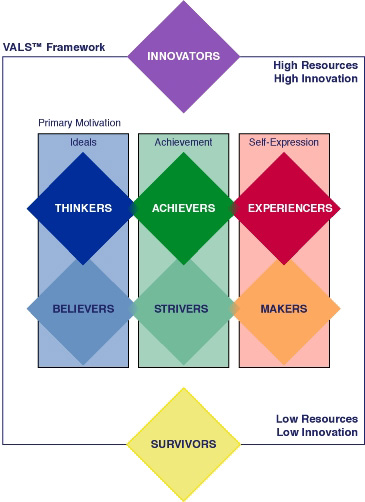
The most widely used lifestyle classification system is the VALS study.  VALS classifies people by their psychological characteristics via four major demographics that correlate with consumer buyer behavior.  The VALS study helps us understand how consumers spend their time and money, and it divides consumers into groups we can understand based on their primary motivations and resources.


Primary Motivations are defined by the consumer's ideals, the achievements they are seeking to attain, and their methods of self expression.  Consumers that are primarily motivated by ideals are usually guided by knowledge and principles.  Consumers that are primarily motivated by achievement tend to look for products and services that demonstrate their success in an outward manner to their peers.  Consumers that are primarily motivated by self expression usually desire social or physical activities that provide their lives with variety and some sense of risk.

Resources refers to the consumer's level of economic, education, health, self-confidence, and "energy" resources.  In a VALS study you are categorized has having high resources or low resources. The resource classification does not have any regard for a consumer's Primary Motivations.  The resource categorization also defines consumers that have extremely high or low resources: Innovators and Survivors.  Innovators have so many resources (ie: usually money since it enables so many things) that they will display all of the primary motiavtors to some degree.  On the other hand, Survivors have so few resources (ie: economically poor) that they usually show no primary motivations at all. These consumers have to focus on meeting needs and not on fulfilling any of their desires.

There is so much more to say about these different classifications of consumers.  Let's dive deeper into the classifications of the VALS study.

Innovators
Innovative consumers are typically defined as sophisticated, successful, "take-charge" people with extremely high self-esteem and self-confidence. Because these consumers have such abundant amounts of resources, they are able to exhibit all three primary motivations at various levels. They are considered to be change and thought leaders.  Innovators are usually extremely receptive to new ideas and technologies in the marketplace. Innovators are very active consumers, and their buyer behavior reflects their tastes for upscale, niche products and services.  Innovators are very conscious about their "image", however not as an outward appearance of their status or power, but as an individual expression of their tastes, style, independence, and personality. Innovators are usually members of the established and emerging leaders in society, business and government, yet they continue to seek new challenges.  They never stand still; they love variety. Their material possessions and recreational activities reflect a preference for the "finer things in life."

Survivors
Survivors live very focused lives. Because they have few resources (mainly economic) with which to exist, these consumers often feel like that the world around them is changing too fast . Survivors are more comfortable with the "familiar" and "traditional", and they are primarily concerned with the safety and security of their families. Because these consumers must focus on meeting needs rather than fulfilling wants and desires, Survivors don't show a strong levels of primary motivations.  Out of the necessity of their situations, Survivors are cautious consumers. These consumers represent a very modest market for most products and services. Survivors tend to be loyal to specific, habitually purchased brands, especially if they are at discounted prices.

Thinkers
Thinkers represent consumers motivated by their ideals. These consumers are more mature, more satisfied, more comfortable with themselves, and are highly reflective.  Thinkers value order in life, knowledge through educational opportunities, and personal responsibility. Thinkers are usually well educated, and eagerly seek out information to aid in the process of decision making. These consumers keep up with current events.  Thinkers have a moderate respect for institutions of authority and social decorum, but they are always open to entertain new ideas. Even though Thinkers usually have incomes that enable them the freedom to satisfy many desires, they tend to be conservative, practical consumers.  Thinkers look for durability, functionality, and value in the products that they purchase.

Believers
Like Thinkers, Believers are motivated by ideals. They are conservative, conventional people with concrete beliefs based on traditional, established codes: family, religion, community, and the nation. Many Believers express moral codes that have deep roots and literal interpretation. They follow established routines, organized in large part around home, family, community, and social or religious organizations to which they belong.  As consumers, Believers are predictable; they choose familiar products and established brands. They favor U.S. products and are generally loyal customers.

Achievers
Motivated by the desire for achievement, Achievers have goal-oriented lifestyles and a deep commitment to career and family. Their social lives reflect this focus and are structured around family, their place of worship, and work. Achievers live conventional lives, are politically conservative, and respect authority and the status quo. They value consensus, predictability, and stability over risk, intimacy, and self-discovery.  With many wants and needs, Achievers are active in the consumer marketplace. Image is important to Achievers; they favor established, prestige products and services that demonstrate success to their peers. Because of their busy lives, they are often interested in a variety of time-saving devices.

Strivers
Strivers are trendy and fun loving consumers. Because they are motivated by achievements, Strivers are concerned about the opinions and approval of others. Money defines success for Strivers, who don't ever seem to have enough of it to meet their desires (which can become viewed as needs for them). These consumers prefer stylish trendy products that give the appearance of the lifestyle of people with greater material riches. Many Strivers see themselves as having a job rather than a career, and a lack of skills, education and focus often prevents these consumers from moving ahead.  However, Strivers are active consumers, because for them shopping is a social activity and an opportunity to show off to people in their circle of influence their ability to buy. Strivers are as impulsive as their financial circumstance will allow them to be, sometimes to their own economic demise.

Experiencers
Experiencers are consumers that are primarily motivated by self-expression. These are younger, enthusiastic, and impulsive consumers. Experiencers will quickly become enthusiastic about new opportunities, but are equally quick to cool it they cannot get what they want soon, or after they have experienced the "high" once or twice. As such, these consumers will seek variety and excitement, savoring the fresh, the "offbeat", and the risky. Their energy (remember that energy is s resource) finds an outlet in exercise, sports, outdoor recreation, and social activities.  They are avid consumers and are willing to spend a high proportion of their income on fashion, entertainment, and socializing activities.  Their buying behavior reflects an emphasis on looking good and having trendy things.

Makers
These consumers, like Experiencers, are motivated by self-expression. Makers express themselves and experience the world by working on it - building a house, raising children, fixing a car, or canning vegetables - and have enough skill, education and energy to carry out their endevours successfully. These consumers are highly practical people who have constructive skills and value self-sufficiency and independence. They usually live within a traditional context of family, practical work, and physical recreation and have little interest in what lies outside that lifesyle.  Makers are suspicious of new ideas and large institutions such as big business. They are respectful of government authority and organized labor but are often resentful of government intrusion on individual rights. Makers are motivated by the accumulation of material possessions other than those with a practical or useful purpose. Because they prefer value to luxury, they buy basic products that meet their needs on a daily basis.

When sales are trending down, conducting a VALS Study is a great way to find new customer segments to sell to.  It is also a great way to understand how to create messaging for these specific customer segments.